
Kategoriler
Yeni blog
LoRaWAN EC Water Quality Sensor Selection Guide: Complete Manual from Parameters to Installation
October 08 , 2026Electrical conductivity (EC) serves as a core indicator reflecting water purity in smart water management, aquaculture and industrial wastewater monitoring. With a wide variety of models available on the market, how can you make an accurate selection? Based on the technical documentation of mature all-in-one LoRaWAN EC transmitters, this article sorts out four core dimensions for model selection.
1. Match Measuring Range with Cell Constant (K-value)
The first step of selection is to define the electrical conductivity range of the target water body. The EC of drinking water is generally 50~1500 μS/cm, clean river water is around 100 μS/cm, while seawater reaches approximately 30000 μS/cm. EC sensors are commonly offered with two cell constant configurations:
Mismatched K-values will cause severe measurement errors. Always select based on the actual EC threshold of the water body.
2. Communication Architecture and Power Supply Requirements
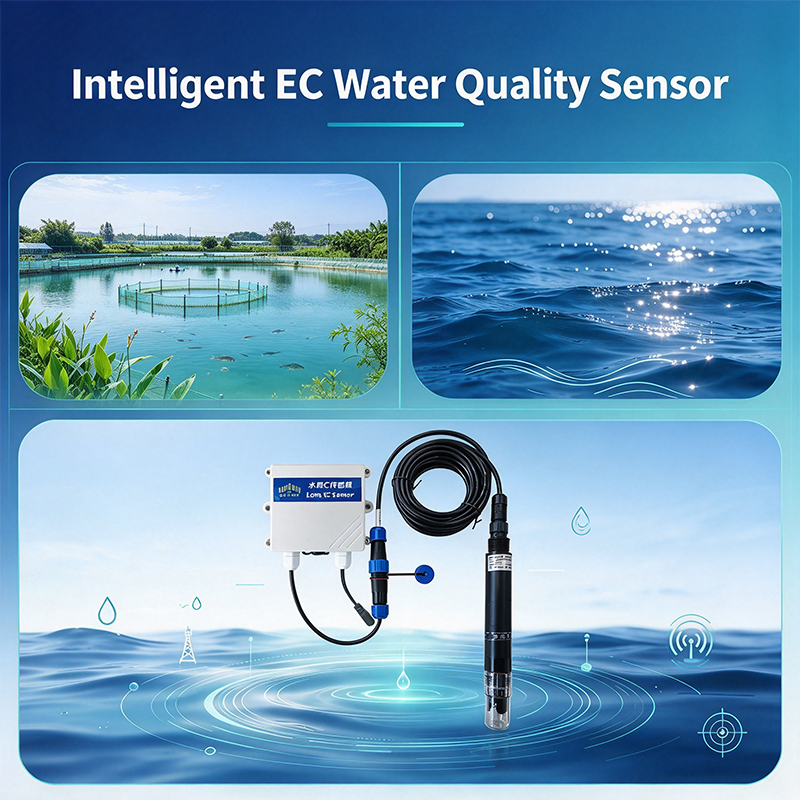
As an all-in-one transmitter, the device embeds a LoRaWAN communication module and can connect to the network directly without an external gateway node. It supports major global frequency bands including CN470/EU868/US915. It is factory-configured for OTAA Class A/C mode, with a default data upload interval of 10 minutes (the device samples and calculates a 10-minute average every minute).
For power supply, the unit supports wide DC voltage of 10~28V (rated 12V), with a standard DC 5.5*2.1mm power connector for easy connection to industrial power supplies. A Type C port is provided for parameter configuration and firmware upgrade, greatly lowering debugging difficulty.
3. Environmental Compatibility and Physical Installation
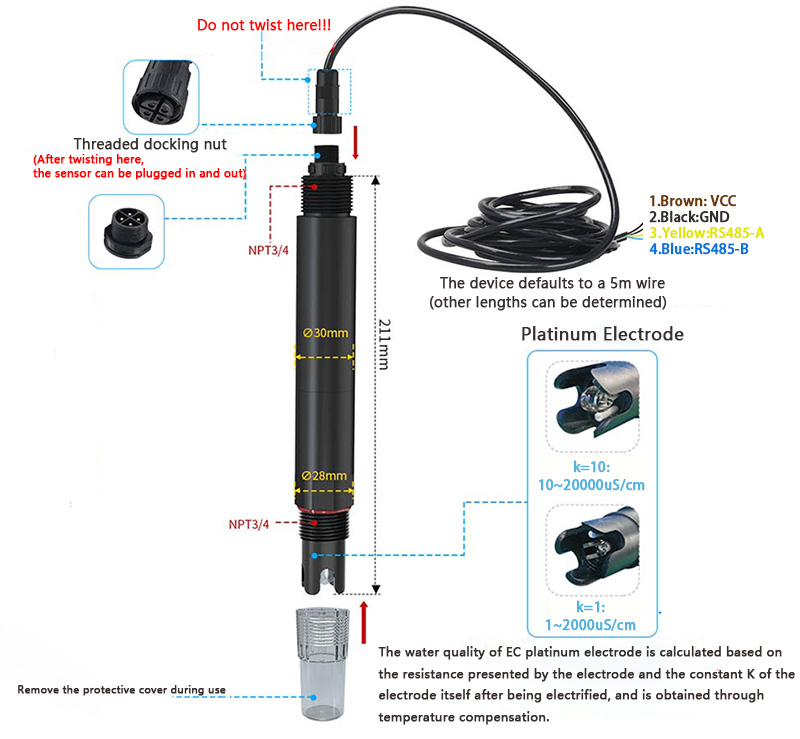
Industrial sites feature harsh conditions, so protection rating and pressure resistance must be considered during selection. The EC probe adopts platinum electrodes with pressure resistance up to 0.6 MPa. It comes with a standard 5-meter cable (customizable) and NPT3/4 thread connection. Technical documents typically list multiple mounting options: sidewall mounting, top flange mounting, in-pipe installation, top insertion, submersible mounting and flow cell installation, well suited for pipelines and open water bodies.
Besides, the built-in temperature sensor achieves ±0.1℃ temperature accuracy. The default temperature compensation coefficient is 0.02 (referenced at 25℃), which effectively eliminates temperature interference on EC readings.
4. Maintenance Cost and Calibration Recommendations
EC sensors require regular maintenance. Calibration every 3 months is recommended (adjustable according to water fouling level). 1413 μS/cm standard solution is used for calibration. Calibration can be triggered via downlink commands (for K=1 probes, multiply the standard value by 10).
Important note: The platinum black coating on platinum electrodes is extremely fragile. Clean only by soaking in 10% citric acid solution or alcohol. Never wipe, otherwise permanent electrode damage will occur. The typical service life of the electrode is about 1 year.
Practical Selection Tips
For projects requiring rapid deployment of LoRaWAN water quality monitoring, the all-in-one design eliminates the hassle of matching separate probes and transmitters. You only need to confirm the EC range of the water body (to choose K=1 or K=10), select the proper frequency band (e.g. EU868 or US915), and prepare NPT3/4 mounting ports. Combined with its default 10-minute upload cycle and 5m cable, you can quickly build a stable and reliable wireless water quality monitoring system.https://www.zonewuiot.com/lorawan_c14

Televizyon : +86 18146178586
Whatsapp : +86 18146178586
E -posta : qui@zonewu.com
Eklemek : 1501-3, Building F03, Phase III, Software Park, Jimei District, Xiamen City, Fujian Province, China